✦The Sourcing Brief spotlight to 218k+ subscribers
In-House Fabric Test Methods & Log
Seven basic in-house tests that identify quality issues before sampling deadlines — requiring minimal supplies and no lab budget.
What's Inside
In-House Fabric Test Methods & Log
Lab testing is the gold standard — but it costs time and money. These seven in-house methods let your team identify the most common fabric quality issues before you commit to a sampling order. Each test uses basic supplies you already have.
GSM / Fabric Weight
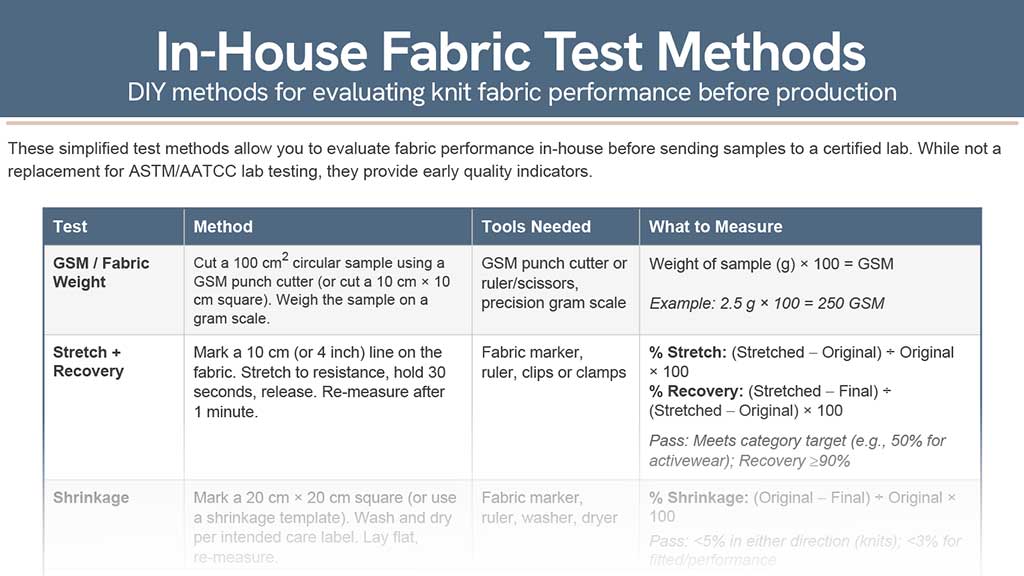
GSM (grams per square meter) tells you if the fabric matches your spec. You can calculate it without a punch cutter using a scale and scissors.
- Cut a 10×10 cm square, weigh it in grams, multiply by 100
- Compare to your tech pack spec — a 10% variance is usually acceptable
- Lightweight (under 150 GSM) suits shirts and blouses; medium (150–250 GSM) suits T-shirts and sweatshirts; heavy (250+ GSM) suits outerwear
Stretch & Recovery
For stretch fabrics, you need to verify both how much the fabric stretches and how well it snaps back. Poor recovery causes bagging and distortion after wear.
- Mark a 10 cm section along the stretch direction
- Stretch to resistance, measure the extended length
- Recovery: hold stretched for 30 seconds, release, measure again after 1 minute
- Pass threshold: 90%+ recovery for activewear; 80%+ for casual knits
Shrinkage
Unaccounted shrinkage causes fit failures between sampling and production. Test before you finalize grading.
- Cut a 20×20 cm square, mark the edges with a fabric pen
- Wash and dry according to your care label instructions
- Re-measure and calculate: (original – final) ÷ original × 100
- Typical allowance: 3–5% shrinkage is acceptable; above 5% requires adjustment
Opacity
Sheerness issues are invisible until you see a model wearing the garment under bright lights. Test opacity before sampling.
- Stretch the fabric to wearing tension against printed text
- If text is legible through the fabric, it will appear sheer on the body
- For stretch garments, test at the stretch tension the wearer would experience
Pilling
Pilling is a surface quality issue that customers notice quickly. Test using friction before committing to bulk.
- Rub the fabric surface against itself (or a wool scrap) for 30–60 seconds
- Rate pilling 1–5: 5 = no pilling, 1 = heavy pilling (same scale as ASTM D3512)
- Any rating below 3 should be flagged to the supplier before bulk
Colorfastness (Crocking)
Crocking is dye transferring to another surface — either when dry or wet. This is a retail compliance test and a customer satisfaction issue.
- Dry crocking: rub white cotton cloth against the fabric 10 times with moderate pressure
- Wet crocking: dampen the white cloth, repeat
- Rate transfer on the white cloth 1–5: 5 = no transfer, 1 = severe transfer
- Retail minimum: 4 dry, 3 wet for most buyers
Torque / Skewness
Torque causes seams to twist after washing — a common problem with single-jersey knits. Catching it early prevents post-production fit complaints.
- Cut a 30×30 cm square, wash and dry
- Lay flat and measure any diagonal distortion in the pattern or selvedge line
- Greater than 5% torque usually requires supplier correction before bulk
Who it's for
QA teams at small brands without lab budgets, designers testing fabrics from a new supplier before committing to bulk, and production managers who need a documented testing record.
What you get
- 7 test methods with step-by-step instructions
- Printable log — one row per fabric sample
- Overall assessment: Approved / Requires Lab / Rejected
- Free, no credit card required
Get the In-House Fabric Test Methods for Free
Enter your email and we'll send the PDF straight to your inbox.
Free download. No spam.
Keep Going