✦The Sourcing Brief spotlight to 218k+ subscribers
Woven Construction Decision Tree
Woven fabric: choosing the wrong fabric at the sourcing stage leads to sampling failures, production delays, and costly revisions. This decision tree helps you narrow fabric options in under a minute by matching garment requirements to the right weave structure.
What's Inside
Woven Construction Decision Tree
Decision paths for six common garment needs — drape, structure, durability, stretch, breathability, and texture — with weave recommendations for each: plain weave, twill, satin, basket, ripstop, jacquard, dobby, and specialty weaves. Includes a quick-reference chart matching garment types to recommended weaves and the key questions to ask before selecting a fabric.
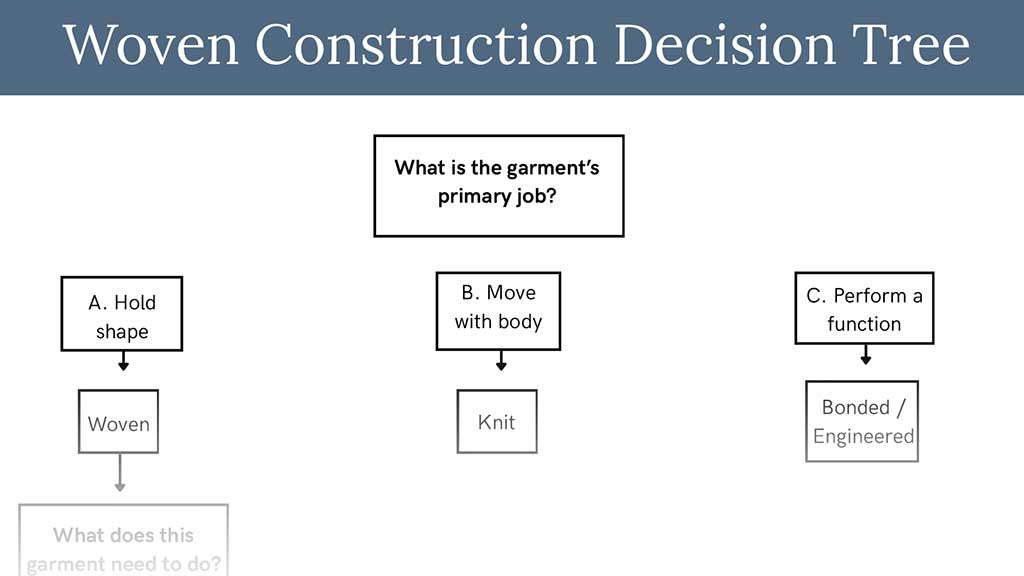
Match the Garment's Job to a Weave
A weave is not decoration — it decides how a fabric drapes, holds shape, breathes, resists wear, and stretches. Start from what the garment has to do, then work back to the structure that delivers it.
- Needs drape → satin or a loose plain weave
- Needs structure → twill or basket weave
- Needs durability → twill or ripstop
- Needs stretch → any weave blended with elastane
- Needs breathability → open plain weave (poplin, voile)
- Needs texture / pattern → jacquard or dobby
The Core Weaves: Plain, Twill, Satin
Most woven garments start from one of three foundational structures. Knowing their default behaviour covers the majority of sourcing decisions.
- Plain weave: over-one, under-one. Balanced, crisp, breathable — poplin, voile, chambray. Best for shirting and lightweight dresses.
- Twill: diagonal rib. Strong, drapes well, hides soil — denim, chino, gabardine. Best for trousers, jackets, workwear.
- Satin: long floats. Lustrous, fluid, snag-prone — charmeuse, sateen. Best for eveningwear, linings, drapey blouses.
Structured & Specialty Weaves
Beyond the core three, specialty weaves solve specific problems — extra strength, dimensional texture, or woven-in pattern that never washes out.
- Basket weave: two-or-more threads grouped. Textured, breathable, less durable — oxford cloth, hopsack.
- Ripstop: reinforcement grid at intervals. Tear-resistant and lightweight — technical outerwear, bags.
- Jacquard: pattern woven on a loom, not printed. Damask, brocade — structured, decorative garments.
- Dobby: small geometric textures woven in — piqué, subtle self-stripes for polos and shirting.
How to Use the Decision Tree
The tree narrows every choice by asking what the garment's primary job is, then pointing to the weave family that serves it. Use it as a first pass before you brief a mill — it keeps the conversation grounded in structure, not just fibre.
- Start with the garment's primary requirement (drape, structure, durability, stretch, breathability, texture)
- Follow the path to a recommended weave family
- Confirm hand-feel and weight against a physical swatch before sampling
- Ask the key sourcing questions in the guide before you commit to a construction
Who it's for
Emerging designers choosing fabric for a new style, buyers evaluating substitutions, and students learning the foundations of textile selection.
What you get
- Decision paths for six garment needs
- Weave recommendations for each path
- Quick-reference garment-to-weave chart
- Instant PDF download — free, no credit card
Get the Woven Construction Decision Tree for Free
Enter your email and we'll send the PDF straight to your inbox.
Free download. No spam.