✦The Sourcing Brief spotlight to 218k+ subscribers
Knits: Part 1—Why Fabric Construction Comes Before Design
Before the Sketch: The Decision That Shapes Everything
When people imagine starting a clothing line, they picture sketchbooks, color palettes, branding, and mood boards. The creative vision feels like the beginning of the process. But before any of that takes shape, there’s a step that determines whether the final product succeeds or fails.
It's research and development (R&D).
R&D begins with a single question: what does the garment need to do?
Is it supposed to stretch and move with the body? Hold a sharp silhouette? Feel soft against skin? Stay wrinkle-free throughout the day? Function during athletic activity?
Once that purpose is defined, the real product development choice becomes which fabric construction method should this garment use to properly live up to its intended capabilities. This is also where many garments potentially fail—long before production, sales, or marketing ever enter the picture. Many unsuccessful products are not bad designs. They simply are the result of poor fabric selection.
Looks Can Be Deceiving
Most consumers have experienced this sort of disconnect without realizing it. Imagine you order two shirts online. They appear nearly identical in photos. Both are labeled “100% cotton.” Both are marketed to the same customer. So it's basically all the same, right? Yet when you wear them, they behave completely differently. One feels comfortable and natural. The other feels restrictive and stiff.
A single fiber, such as cotton, can become a soft t-shirt, a dress shirt, or a rigid canvas jacket. The fiber remains the same, but the physical behavior changes dramatically depending on how the yarns are formed into fabric.
Pro Tip: Not all cotton is equal—the difference is staple length. Ordinary cotton fibers measure 2–2.5 cm; long-staple varieties like Supima and Egyptian Giza run 3–3.5 cm or longer. That extra centimeter means smoother yarn, less pilling, and a softer hand that lasts. This is why two "100% cotton" shirts can feel completely different. Watch for more details
Before someone starts to design clothing or source materials, they must understand the fabric’s physical properties—because garment behavior is determined by its fabric structure. If you misunderstand how fabric construction methods affect how your product wears, then its lifespan in your customers' closets can fall flat.
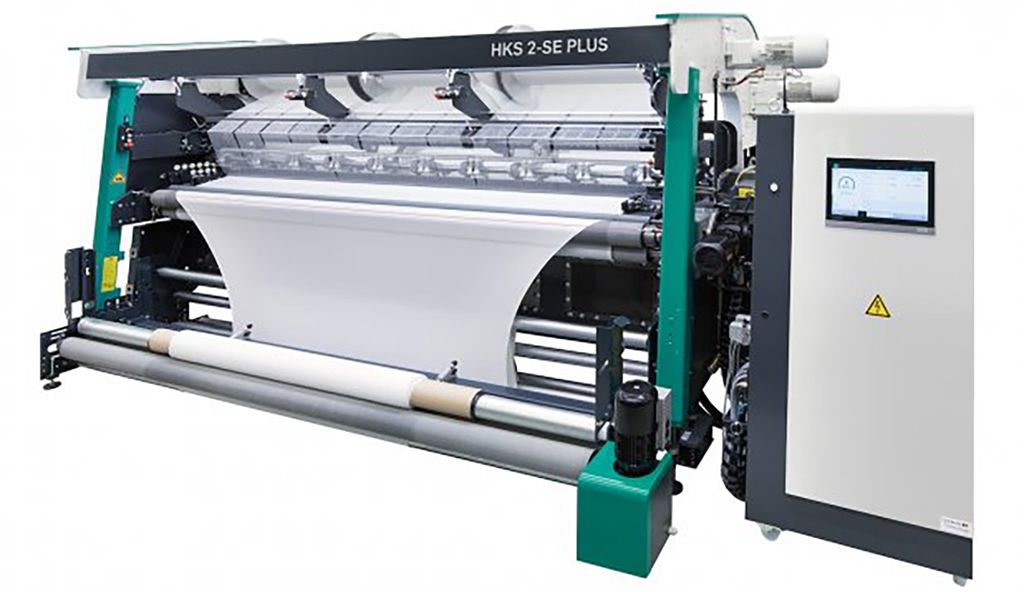
Fabric Is Defined by Structure, Not Just Fiber
In apparel manufacturing, textiles are not primarily defined by their fiber content like cotton, wool, or polyester. Instead, they are defined by how the fibers and yarns are assembled. Fabric construction determines the mechanical properties of a textile: its stretch, drape, recovery, and wrinkle resistance.
These properties directly influence how a garment moves on the body, how it fits different customers, how it ages, and whether a customer keeps or returns it.
Fiber still matters. Fiber choice affects hand feel, breathability, and certain aspects of durability. Fabric construction, however, determines performance. Together, they decide whether a garment will function as intended. That’s why understanding a fabric’s structure is one of the most valuable skills a future designer or product developer can master.
Pro Tip: When evaluating a supplier's swatches, don’t just check fiber content. Look at the fabric construction to make informed decisions.
The Three Fabric Constructions in Apparel
All apparel textiles fall into one of three fabric structures. Understanding these categories helps you identify what you're working with—and what it's capable of.
Knits—Movement: Knit fabrics are created by forming yarns into interlocking loops. Because loops are able to expand and contract, knits stretch naturally without requiring elastic fibers.
-
Key behaviors: Flexible, body-conforming, breathable, wrinkle-resistant, comfortable for extended wear
-
Common garments: T-shirts, leggings, underwear, loungewear, activewear
-
Choose knit when: The garment must move with the wearer
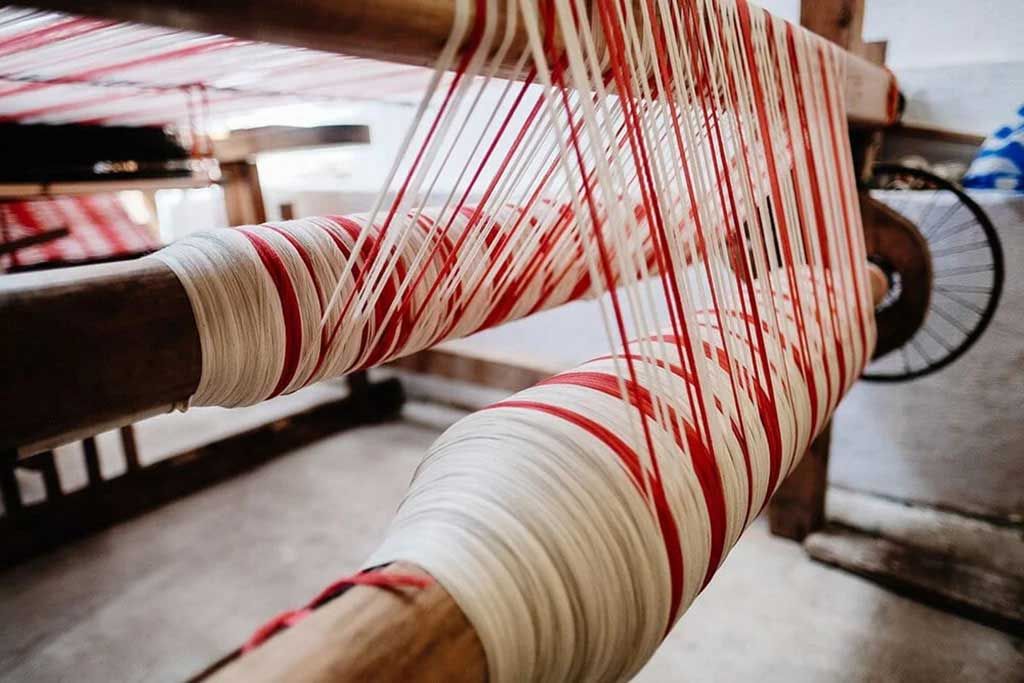
Woven—Structure: Woven fabrics are made by interlacing two sets of yarns—one running vertically (warp) and one running horizontally (weft)—at right angles on a loom. The yarns lock into position, creating stability.
-
Key behaviors: Holds shape, supports tailoring, durable, minimal natural stretch
-
Common garments: Button-downs, trousers, blazers, denim, uniforms
Bonded / Engineered Fabrics—Function: Bonded or engineered fabrics are not woven or knitted. Instead, fibers or layers of material are fused using heat, pressure, adhesives, and/or lamination. These textiles are designed for function.
-
Key behaviors: Water resistance, wind protection, compression, thermal insulation
-
Common garments: Outerwear shells, shapewear, technical athleticwear
We’ll explore wovens and bonded fabric construction in dedicated articles. For now, let’s go deeper on knits.
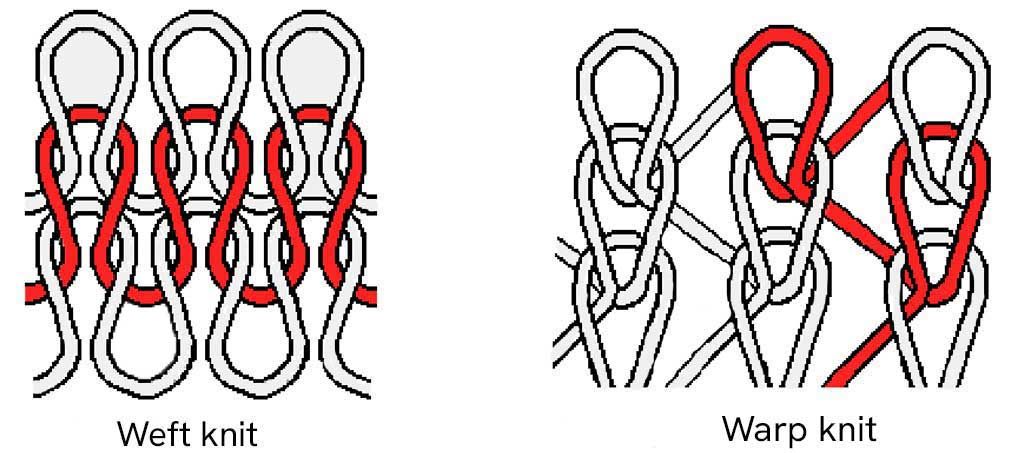
The Two Families of Knits: Weft vs Warp
Not all knits behave the same, and the difference comes from how the loops are formed.
Weft knits are created using a single yarn that travels horizontally across the fabric, forming rows of loops one course at a time. They can be produced on circular machines (creating seamless tubular fabric for t-shirts and basics) or flatbed machines (creating flat rolls of fabric for cut-and-sew production). They are soft, flexible, and comfortable—but less dimensionally stable.
Warp knits are formed differently. Multiple yarns run vertically, forming loops simultaneously across the width of the fabric. Produced on specialized tricot, raschel, or Milanese machines, warp knits are more stable, less prone to runs, and commonly used in activewear, swimwear, and lingerie.
Each family includes specific knit structures. Weft knits include jersey, rib, purl, interlock, and French terry. Warp knits include, mesh/netting, spacer fabric, velour, and locknit. Each behaves slightly differently, but they all share the defining characteristic of looped fabric structure.
Sweaters are knit fabrics too, but their construction process differs from cut-and-sew knits. We’ll cover them in a future article.
Common Weft Knit Types
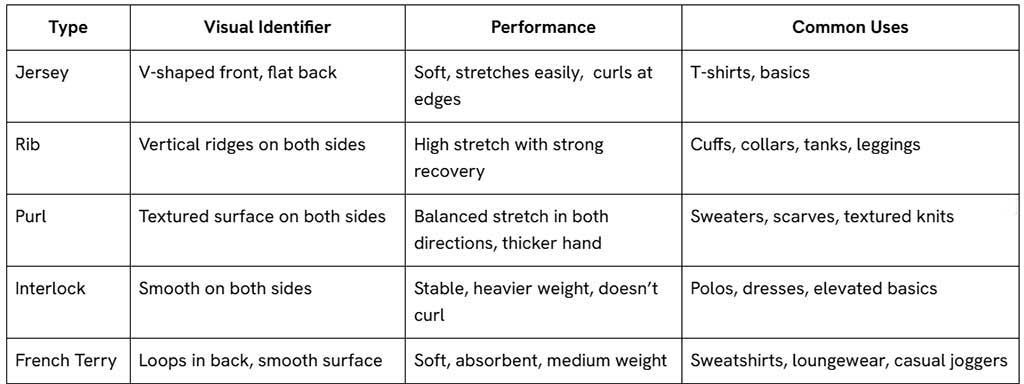
Common Warp Knit Types

It may seem overwhelming, but the key distinctions between these two families of knits are:
-
Weft knits prioritize comfort and softness, making them ideal for garments worn against the skin
-
Warp knits prioritize stability and performance, making them ideal for garments that need to hold up under stress or movement
Knit fabrics are categorized by weight, measured in grams per square meter (GSM). A lightweight jersey (120-150 GSM) drapes differently than a heavyweight interlock (250+ GSM). Weight affects drape, opacity, and application—we’ll cover this in depth throughout this series.
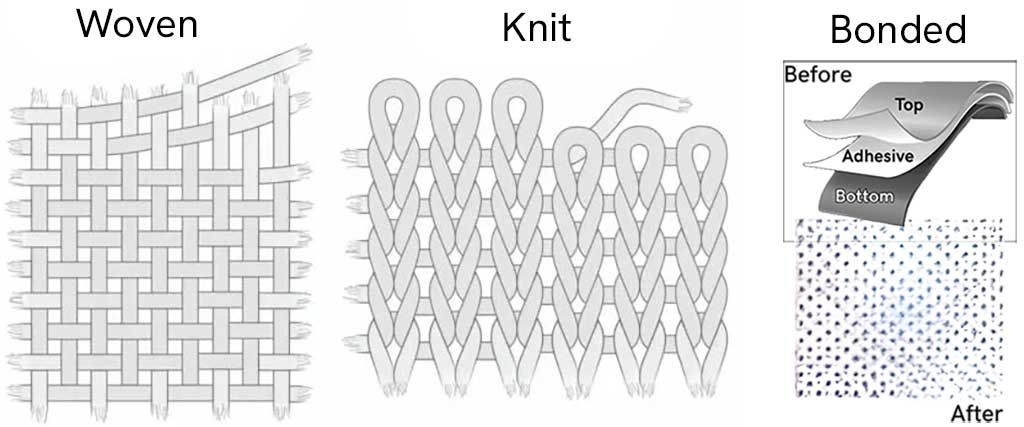
Performance Comparison - How Fabric Structure Changes Physical Performance
Although this series is focused on knits, understanding how all three fabric construction methods compare helps you to make informed decisions—especially when evaluating what your product actually needs.
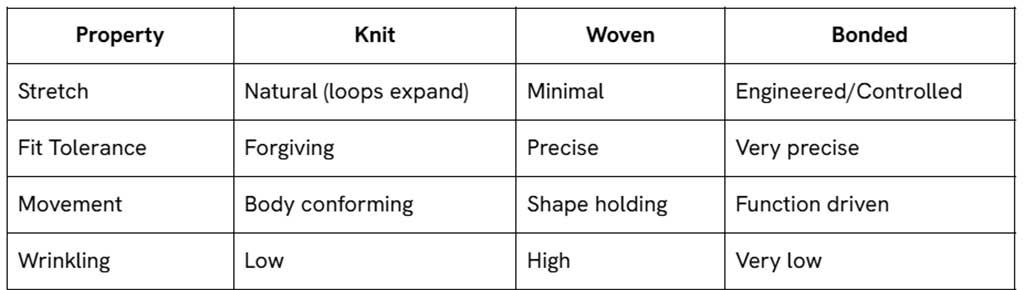
Matching fabric structure to garment function is the first step towards a successful product, and the foundation for everything we’ll cover in this series.
Why This Matters for Your Bottom Line
Misunderstanding fabric construction is not only a technical mistake—it is a business mistake. If the choice is incorrect, garments fit poorly, customers leave negative reviews, and high return rates. Samples must be remade, production is delayed, and costs rise. Perhaps most damaging, customers lose trust in the brand.
Many startups design a garment that requires knit performance—natural stretch and body-conforming fit—but manufacture it using woven fabric. Or the reverse: they spec a structured garment in a knit that won’t hold its shape. The garment may be produced according to the tech pack, but it will never function the way customers expect.
FAQ
What is the difference between weft knit and warp knit?
Weft knits are formed by a single yarn traveling horizontally across the fabric, creating soft, flexible fabric with less dimensional stability. Warp knits are formed by multiple yarns running vertically and looping simultaneously, creating a more stable fabric that is less prone to runs.
Why does fabric construction matter more than fiber content?
Fiber content affects hand feel and breathability, but fabric construction determines mechanical performance, including stretch, drape, recovery, and wrinkle resistance. Two garments made from the same fiber can behave completely differently depending on how the yarns are constructed.
What is GSM in knit fabric?
GSM stands for grams per square meter and measures fabric weight. Lightweight knit jersey typically runs 120 to 150 GSM, while double-knit interlock typically runs heavier at 180 to 260 GSM. While GSM indicates weight, the specific fabric construction dictates the final thickness, drape, and opacity.
How is knit fabric different from woven fabric?
Knit fabric is formed by interlocking loops of yarn, which allows it to stretch naturally. Woven fabric is made by interlacing two sets of yarns, warp and weft, at right angles on a loom, which creates stability but minimal natural stretch.
What's Next: Sourcing Quality Knit Fabric
Now that you understand why fabric’s structure matters, the next step is learning how to apply that knowledge. In Part 2, we’ll show you where to find knit fabrics and how to evaluate suppliers.
Download the Fabric Construction Decision Tree—a visual guide to choosing the right fabric structure for your garment.
Related articles:
Knits: Part 2—How to Source Quality Knit Fabric
Knits: Part 3—Innovation: Reimagining What a Knit Can Be
Knits: Part 4—Evaluating Knit Fabric Performance: From Feel to Proof
Getting Started
For readers in the early planning stages:
I have a great idea for a fashion product – how do I start?
Essential Tips for Small Fashion Business Success
Go from Fashion Influencer to Fashion Entrepreneur using Fashion Index
What Is Adaptive Fashion? A Complete Guide to Inclusive Design
Apparelmark: Turning Fashion Ideas into Market-Ready Brands with Full-Service Design
Before You Source
For readers preparing to contact suppliers:
Are You Ready to Get a Sample Made?
11 Common Mistakes in Starting a Fashion Business
Lowering Costs For Start-Up Fashion Brands
How to Write a Sourcing Inquiry That Gets a Response
Understanding Knit Fabric Series
How to Start a Fashion Brand: An Essential Guide For Founders
Technical Knowledge
For readers building their production fluency:
A Beginner's Guide to Stitch Types
Thread Characteristics: From Fibers to Finishes
Plant-Based Leather Alternatives
Comments
Loading comments…