✦The Sourcing Brief spotlight to 218k+ subscribers
How Woven Fabrics Are Dyed, Finished, and Tracked
I love your outfit! Where did it come from? Most would name the retail store or brand. Few could tell you where the fabric was woven, dyed, or finished.
A woven fabric can pass through five or six hands before it reaches a cutting table: spinner, weaver, dyehouse, finisher, converter. Each step uses water, chemistry, and energy, and until recently, very few left a record a brand could use. Woven fabric processing innovation covers the new dyeing, finishing, development, and tracking methods that follow a woven fabric from the mill to the finished product.
I’ve seen plenty of game-changing processes through the years. Some deliver real savings in water and chemicals and help brands stay ahead of regulations. Others never get past the pilot stage. The question that separates them is simple: can the mill manufacture at scale? Knowing which is what keeps a sourcing plan realistic.
Innovation in Dyeing and Finishing
Conventional dyeing and rinsing are among the most water-intensive steps in textile production. Two approaches stand out.
Waterless and Low-Water Dyeing
Supercritical carbon dioxide (CO₂) dyeing replaces water with pressurized CO₂, which dissolves the dye and carries it into the fiber. It produces no wastewater, eliminates the drying stage, and recycles about 95% of the CO₂. Digital methods take a different approach. Digital dyeing applies solid color across the fabric in controlled dye amounts instead of a full dye bath, and inkjet printing places color only where the design calls for it.
CO₂ dyeing and digital dyeing work best on polyester. CO₂ dyeing relies on disperse dyes, which are made for synthetics. Cotton, linen, wool, and silk need reactive or acid dyes that do not dissolve in CO₂, so natural fibers remain the open gap. Digital printing on cotton is commercially available, but reactive inks still require fabric pretreatment and post-print washing, which narrows the water savings. Pigment inks need less water and cure with heat instead of a wash, though they leave a slightly firmer hand.
The science works. The obstacles are fiber limits and cost. CO₂ dyeing machines require significant capital investment, and the payoff is mainly water and wastewater savings. In regions where water is cheap, that payoff is hard to justify, so relatively few mills have made the switch. For woven programs built on natural fibers, the more accessible upgrades are low-liquor-ratio dyeing equipment and improved water recycling at the dyehouse. Ask your mill what it runs today, not what it is piloting.
PFAS-Free Water Repellency
Per- and polyfluoroalkyl substances (PFAS), also known as forever chemicals, have been the standard for durable water repellency for decades. That’s ending.
California and New York banned intentionally added PFAS in apparel as of January 2025, with an exemption for outdoor apparel designed for severe wet conditions that runs until January 2028. France’s ban on PFAS in clothing and footwear took effect in January 2026. The EU restriction on PFHxA, a PFAS subgroup common in water-repellent finishes, began applying to consumer clothing in October 2026. The EU is still reviewing a broader restriction covering the entire PFAS class.
For woven outerwear and performance fabrics, the main non-fluorinated alternatives are silicone-based finishes, wax and paraffin-based treatments, and hydrocarbon-based finishes. Hydrocarbons are chemically bonded or crosslinked onto the fibers, helping them hold up better than simple coatings. All of them repel water. The trade-off is that these fluorine-free finishes (the F in PFAS refers to fluorine in the molecule) generally don’t repel oil, and durability varies widely. Some hold up through many washes, while others fade quickly and depend on heat reactivation or reapplication.
Choosing a PFAS-free finish balances four factors: water repellency, wash durability, fabric performance (hand, breathability, color), and environmental impact. Request spray rating results before and after laundering, not just on fresh fabric, and confirm the finish suits the end use. A rain shell and a cotton trench coat do not need the same treatment.

AI-Assisted Fabric Development
Artificial intelligence is starting to support fabric development at the mill level, including weave design, material selection, performance prediction, and fewer rounds of physical sampling.
One example comes from research with a Portuguese textile company. Using the mill’s own production records, researchers trained machine learning models to predict nine physical properties of woven fabrics, including abrasion, elasticity, and pilling, from design and finishing inputs. The best models predicted those properties with errors of roughly 2% to 7%, and adding finishing data improved accuracy for eight of the nine. The stated goal was to reduce production attempts, saving both time and cost.
The catch is that those results came from the mill’s own structured data. A model is only as good as the records behind it, and many mills still don’t capture yarn specifications, loom settings, and finishing parameters. AI can shorten the path to a sample worth testing, but physical testing should be used for final approval.
Supply Chain Verification and Compliance
Traceability in woven garments is the ability to document and verify each process a garment undergoes after weaving, including dyeing, washing, coating, and trim application, along with who performed it, where, and with which chemicals and materials.
Fiber Origin and Recycled Content
Traceability starts with the fiber. Under the Uyghur Forced Labor Prevention Act (UFLPA), goods made wholly or in part in Xinjiang, China are presumed to involve forced labor and can be detained at US ports unless the importer proves otherwise.
That’s why a fabric woven in Vietnam from Xinjiang cotton is still covered under UFLPA.
Paperwork alone does not always hold up, so some brands now test the fiber itself. As a plant like cotton grows, it absorbs elements from the local soil, water, and air, leaving a chemical “fingerprint” of isotope ratios and trace elements that vary by region. Comparing a sample with reference data shows whether the sample is consistent with its claimed origin. In 2026, the U.S. Cotton Trust Protocol began using this kind of testing to verify the origin of cotton in its members’ yarn and fabric.
For recycled and organic content, third-party certifications remain the baseline. The Global Recycled Standard (GRS) verifies recycled content, and the Global Organic Textile Standard (GOTS) verifies organic fiber; both are supported by transaction certificates that track the material through each stage of the supply chain. A certificate on the mill’s wall does not cover your specific order. The transaction certificate does.
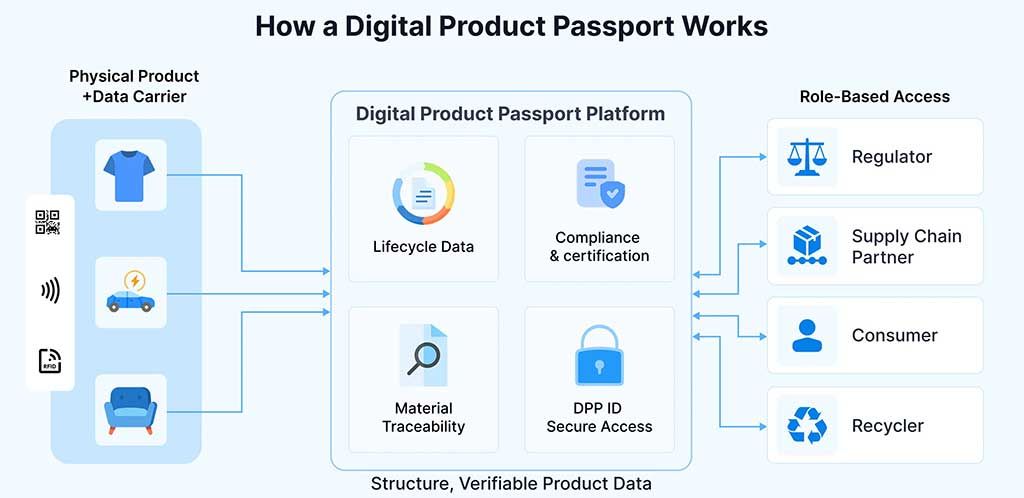
Digital Product Passport
The EU’s Digital Product Passport (DPP) will create a digital record for each product, accessed through a QR code or similar data carrier. For textiles, it is expected to include fiber origin, recycled content, and processing information.
The textile-specific rules are expected in late 2027. Brands will then have a transition period of at least 18 months after adoption, so requirements are unlikely to take effect before 2029.
US brands selling into the EU should start organizing their data now anyway. The information a passport will require, such as fiber origin, mill and dyehouse locations, certifications, and composition, lives with your suppliers. Building the habit of collecting it at the purchase order stage is far easier than reconstructing it later for products already in production.
Designing for Circularity
Circularity in woven garments means designing fabrics and products to be worn longer, repaired, and eventually recycled into new textiles, keeping materials in use and out of landfills.
Laws like California’s Responsible Textile Recovery Act are shifting responsibility for discarded textiles to the brands that produce them.
Circular Textile Initiatives
Textile-to-textile recycling partnerships, brand take-back programs, and fiber-recovery technologies are giving discarded woven fabrics new uses.
Mechanical recycling of single-fiber cotton and wool is commercially established. Chemical recycling of polyester and cellulosics is scaling. Enzymatic processes that separate blended fibers, breaking down one fiber in a poly-cotton blend so the other can be recovered, could make some of the most difficult textiles recoverable, but most remain at pilot or early commercial scale. When a supplier describes a recycling solution, ask how many tons it processed last year and its capacity going forward.
Recovery is only half the question. The quality and consistency of recovered material determine whether it meets the requirements of a new woven fabric. When I was at Gap, I researched cotton staple lengths, weighed cost against performance, and landed on 28 millimeters as the optimal length for our program. Mechanically recycled cotton comes out shorter than virgin fiber, so it is usually blended with it to reach the yarn strength a tight weave needs.
Circular Design Choices for Woven Fabrics
Circularity is decided at the design and development stage, long before a garment reaches a collection bin.
-
Build for durability and repairability: Strong seams, abrasion-resistant constructions, and replaceable components extend the product’s life cycle
-
Choose blends that can be separated: Single-fiber fabrics are the easiest to recycle. When a blend is needed for performance, confirm a recovery route exists
-
Limit coatings, finishes, and added components: Laminates, heavy coatings, and some chemical finishes can interfere with material recovery
-
Design for disassembly: Trims, linings, and hardware that detach easily make the main fabric easier to recover
-
Coordinate with suppliers and recycling partners: Bring your mill and recycler into development early. They’ll tell you what they can actually process, before you’re committed to materials they can’t
Woven Garment Dyeing, Finishing, and Tracking Innovation
|
Innovation |
Status today |
|
CO₂ dyeing |
Commercial for polyester; not for natural fibers |
|
PFAS-free water repellency |
Commercial; durability varies by chemistry |
|
AI-assisted fabric development |
Early; depends on the mill’s own data |
|
Isotopic fiber origin testing |
Commercial |
|
Mechanical recycling (cotton, wool) |
Commercial |
|
Enzymatic blend separation |
Pilot or early commercial |
Innovation improving the sustainability of woven garments.
Innovation to Application
Woven fabric production is changing faster than many brands realize. New dyeing methods, PFAS-free finishes, AI-assisted development, better traceability, and recycling technologies each emerged to solve problems. The key is knowing what is still in the pilot stage versus what's in volume production, and how each aligns with your goals. The best innovations often start with the challenge, whether that is a regulation, a performance gap, or a cost. Start there, ask your mill what it can run today, and you’ll be ready as more of these options reach scale.
This wraps up our woven series. If you’re just joining, start with Why Woven Construction Matters.
Wovens are complicated. What did we miss?
FAQ
What is woven fabric processing innovation?
Woven fabric processing innovation covers the new dyeing, finishing, development, and tracking methods that follow a woven fabric from the mill to the finished product. It includes waterless dyeing, PFAS-free water repellency, AI-assisted fabric development, fiber origin testing, and design for recycling.
Does waterless dyeing work on cotton?
Not yet at commercial scale. Supercritical CO₂ dyeing relies on disperse dyes made for polyester and other synthetics. Cotton, linen, wool, and silk need reactive or acid dyes that don’t dissolve in CO₂, so low-liquor-ratio dyeing and dyehouse water recycling are the more practical upgrades for natural fibers today.
Are PFAS banned in clothing?
In several markets, yes. California and New York banned intentionally added PFAS in apparel in January 2025, with outdoor apparel for severe wet conditions exempt until January 2028. France banned PFAS in clothing and footwear in January 2026, and the EU restricted PFHxA in consumer clothing in October 2026.
How does UFLPA affect woven fabric sourcing?
The Uyghur Forced Labor Prevention Act presumes that goods made wholly or in part in Xinjiang, China involve forced labor. A fabric woven in another country from Xinjiang cotton is still covered, so importers need documentation, and sometimes isotopic fiber testing, to prove the cotton’s origin.
When will the Digital Product Passport apply to textiles?
The EU’s textile-specific rules are expected in late 2027, with a transition period of at least 18 months, so requirements are unlikely to take effect before 2029. US brands selling into the EU can start collecting fiber origin, mill locations, certifications, and composition data from suppliers now.
What is traceability in woven garments?
Traceability in woven garments is the ability to document and verify where the fiber came from and every process the fabric goes through, including dyeing, washing, coating, and trim application, who performed it, where, and which chemicals and materials were used.
What does circularity mean for woven garments?
Circularity in woven garments means designing fabrics and products to be worn longer, repaired, and eventually recycled into new textiles, keeping materials in use and out of landfills.
Related Articles
Woven Fabric Series
Why Woven Construction Matters
Understanding Fabric Weave Structure
Evaluating Woven Fabric Specifications
How Fabric Finishing Shapes Woven Textile Performance
How To Navigate Woven Fabric Sourcing
Woven Fabric Innovation: New Fibers, Recycled Yarns, and Advanced Weaving
How Woven Fabrics Are Dyed, Finished, and Tracked
Getting Started
For readers in the early planning stages:
I have a great idea for a fashion product – how do I start?
Essential Tips for Small Fashion Business Success
Go from Fashion Influencer to Fashion Entrepreneur using Fashion Index
What Is Adaptive Fashion? A Complete Guide to Inclusive Design
On-Demand vs. Batch Manufacturing
Before You Source
For readers preparing to contact suppliers:
Why Apparel Manufacturing Takes Longer Than You Expect
Are You Ready to Get a Sample Made?
11 Common Mistakes in Starting a Fashion Business
Lowering Costs For Start-Up Fashion Brands
How to Write a Sourcing Inquiry That Gets a Response
Understanding Knit Fabric Series
How to Start a Fashion Brand: An Essential Guide
Technical Knowledge
For readers building their production fluency:
A Beginner's Guide to Stitch Types
Thread Characteristics: From Fibers to Finishes
Plant-Based Leather Alternatives


Comments
Loading comments…